The Explainer
How portable saunas work: four ways of making heat
A portable sauna is not one technology. It is four different ways of transferring heat to a person, sold under one name — and almost every disappointment in this category comes from expecting one format to behave like another. This page explains, in plain terms, how each format actually works, the temperatures each one really reaches, what a session costs to run, and why these products fit apartments and rented homes in a way a built-in sauna never could.

How to read this page: This is a research-based assessment. We do not test units in-house; we work from published specifications, manufacturer documentation, regulatory filings and owner reports, and we say so wherever a number comes from the brand itself. Prices checked November 2026 — they change, and the seller's page wins.
Steam: hot, humid air
A portable steam sauna is the simplest machine on this page. A separate steamer unit — essentially a large, controlled kettle — boils water and sends the vapour through a hose into a fabric tent where you sit on a folding chair. The air inside climbs to roughly 110–140°F, and because it is saturated with moisture, the humidity sits at effectively 100%. The SaunaBox SmartSteam Pro, the category's best-known model, publishes 130–140°F from a 3.6-litre steamer, with a setup time of about ten minutes.
The heat transfer here is mostly convection and condensation. Warm, wet air surrounds you, and as moisture condenses on your cooler skin it gives up its heat directly to you. That second part is why steam feels so much more intense than its temperature suggests: dry air at 130°F and saturated air at 130°F are very different experiences, and the wet version wins. It is also why steam has a hard ceiling in a fabric tent. The enclosure, the steamer's output and the physics of humid air all settle in the same range, and no portable steam tent reaches the dry, fierce temperatures of a Finnish sauna. Judged on its own terms — enveloping, humid, deeply warming — it does not need to.
Steam's practical quirks follow from the water. You fill the steamer before a session (there is no plumbing involved; you carry the water to it), you empty and wipe it down afterwards, and you leave the tent open to dry fully before packing it away. The known complaint pattern in this category — leaks around fittings, and mould smells in tents stored damp — traces back to that routine. Owners who dry their tents report few problems; the care is part of the format, and our portable steam sauna guide covers it in full.
Infrared: radiant heat, cooler air
An infrared portable works on a different principle entirely. Instead of heating the air around you, panels inside a fabric tent emit infrared radiation that warms your body directly — the same basic mechanism by which sunlight warms your skin on a day when the air itself is cold. Most portable infrared models are “head-out” designs: you sit on a chair inside the tent with your head outside it, breathing ordinary room air while the panels work on everything below the neck.
That mechanism explains infrared's numbers, which confuse people more than any others in this category. Because the air is not the medium, air temperature is not the whole story, and published figures vary widely by model and by what the maker chooses to measure. A Durasage publishes panel settings of 104–140°F. The HeatWave Rejuvinator publishes up to 150°F. The TheraSage Thera360 Plus — a full-spectrum design combining near, mid and far infrared panels with red-light panels — publishes 100–170°F, and premium alternatives such as the Relax Sauna use semiconductor far-infrared emitters rather than conventional panels, at prices from $1,700. The honest way to compare these products is by their published ranges, their panel technology and their build — not by expecting any of them to reproduce the sensation of very hot air, which is a different format's job. Our portable infrared sauna guide ranks the ladder model by model.
People who settle happily into infrared tend to cite the same things: the warmth feels focused and intense, sessions feel easier to complete with their head in cool air, heat-up is quick, and there is no water to fill, empty or dry. People who return infrared tents tend to cite one thing: they wanted a hot room, and this is not one. Neither group is wrong about the product. They wanted different physics.
Wood-fired: true convective sauna heat
The wood-fired tent is the oldest technology here and, in temperature terms, the strongest. A small wood-burning stove sits inside an insulated outdoor tent, with sauna stones on or around it. Burning wood is not limited by what a household outlet can deliver, so the air inside climbs to 180–220°F — genuine Finnish sauna temperatures, reached by convection: the stove heats the air, the air heats you. Throw water on the hot stones and you add a burst of steam to the dry heat, the traditional way. The SweatTent is the format's reference product: a complete $1,499 kit with tent, stove, stones and bench, designed to go up outdoors and pack away afterwards.
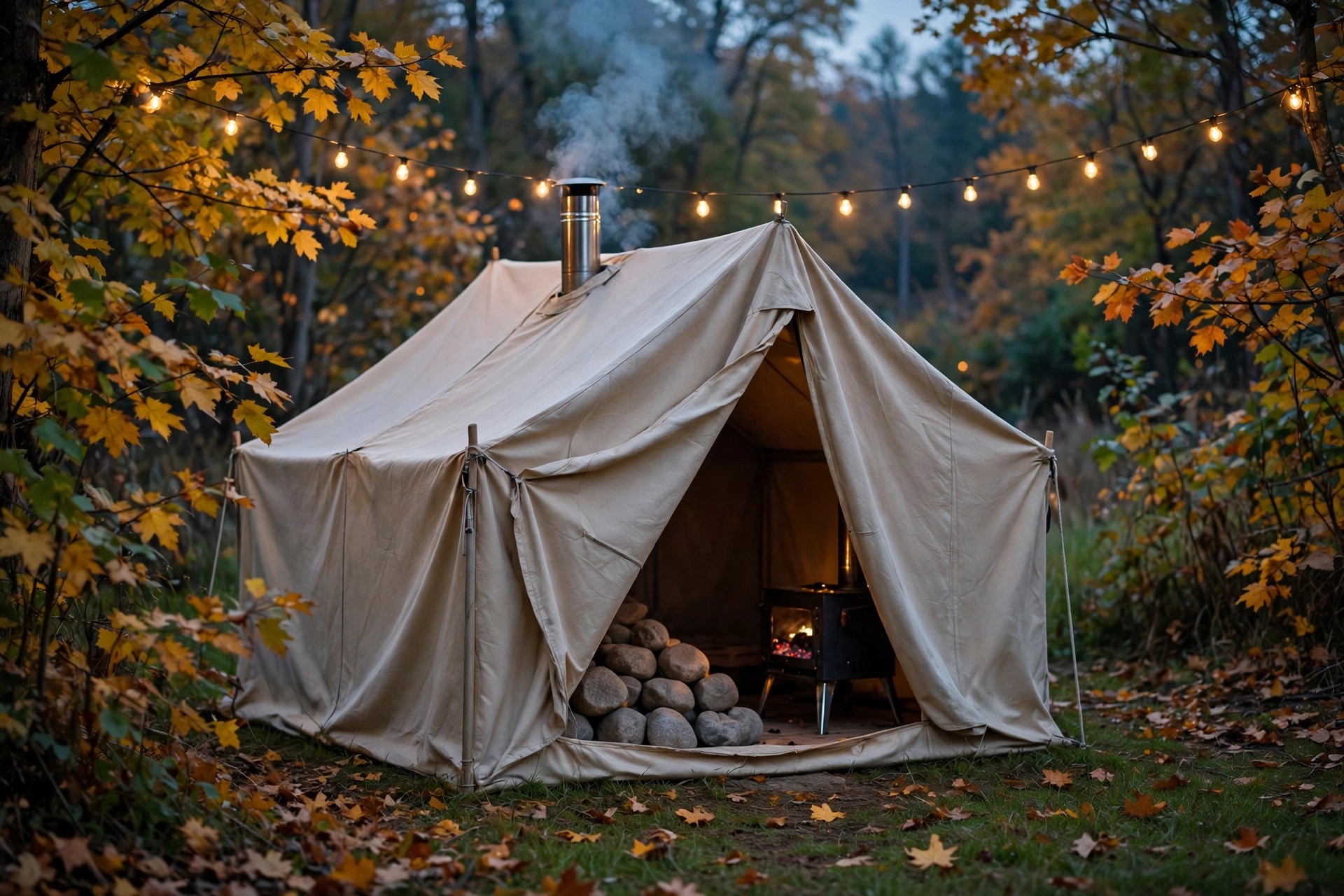
The trade-offs are the mirror image of the plug-in formats. There is no electricity at all, which makes the format work anywhere outdoors — a yard, a rural property, a campsite. But there is a real fire to build, feed and respect: proper clearance around the stove and chimney, attention to local fire rules, dry storage for the kit, and time for the heat to build before anyone gets in. It is a ritual with a beginning, a middle and an end, and for the people who love it, that is precisely the appeal. Our Sweat Tent review walks through what a session actually involves.
Blankets: contact heat, and surface temperatures
A sauna blanket removes the tent altogether. Heating elements are built into a wrap that zips around you as you lie on a bed, a sofa or the floor, so the heat reaches you by direct contact and by the infrared elements warming the enclosed space against your body. Your head stays outside, the footprint during use is the size of a person lying down, and the storage footprint afterwards is a folded bundle in a drawer or cupboard — the smallest of any format on this page.
The one thing to understand before buying any blanket is its temperature figure. Blanket temperatures describe the surface heat inside the wrap, where the elements sit close to you. They are not air temperatures, and they cannot be compared degree-for-degree with a steam tent's 130–140°F or a wood-fired tent's 200°F-class heat. A blanket session can feel intensely warm — direct contact is an efficient way to feel heat — but the number on the box belongs to a different measurement, and honest retailers of your attention will keep it in its own column. Prices run from $69.99 at the budget end to $699 for premium names, with the LifePro RejuvaWrap at $272.99–$299.99 in the middle; the known complaint pattern across the budget end is durability — zippers, controllers and seams — so warranty terms deserve a read before price does. See the sauna blanket guide and our sauna vs. sauna blanket comparison.
The real-temperature table
| Format | How the heat reaches you | Real temperature | What the number measures |
|---|---|---|---|
| Steam tent | Hot, saturated air; condensation on skin | ~110–140°F (SmartSteam Pro: 130–140°F) | Air temperature, at ~100% humidity |
| Infrared tent | Radiant panels warming the body directly | 100–170°F by model (Durasage panels 104–140°F; Thera360 Plus 100–170°F) | Published panel / in-tent range — air stays cooler than in a hot-air sauna |
| Wood-fired tent | Convection: a stove heats the air; water on stones adds steam | 180–220°F | Air temperature — true Finnish sauna range |
| Sauna blanket | Contact: elements inside a wrap, against the body | Surface temperatures inside the wrap | Surface heat — not an air temperature, and not comparable degree-for-degree |
Read that table before you read any advertisement, and the category becomes legible. Only one row reaches Finnish heat. One row's number is not an air temperature at all. And the two middle rows feel far hotter than a bare degree figure suggests, each for its own physical reason — humidity in one case, direct radiant warmth in the other.
What a session costs to run
Running costs are where portable saunas quietly beat every built-in alternative, and the arithmetic is simple enough to do from published figures. Electricity is billed in kilowatt-hours: one kilowatt-hour is 1,000 watts running for one hour. So a session's cost is the unit's wattage, multiplied by the hours it runs, divided by 1,000, multiplied by your electricity price.
Work it with two real published wattages from our product research. The Durasage portable infrared is a 900W unit. Run it for a 30-minute session and it uses 900 × 0.5 ÷ 1,000 = 0.45 kWh. At an illustrative US average electricity price of about $0.17 per kWh — an example rate we are using to make the maths concrete, not a researched figure for your address — that session costs roughly 8 cents. The Dr.Fuji FJ-1000, a 1050W far-infrared unit, uses 1050 × 0.5 ÷ 1,000 = 0.525 kWh in the same half hour, which at the same illustrative rate is about 9 cents. Even doubling the session length, or assuming your local rate is well above the example, a plug-in portable session stays in the range of loose change. Heat-up time adds a little — the unit draws power while it warms, before your session clock starts — but it does not change the order of magnitude.
The other formats price their running costs differently. A steam tent's cost is the same electricity arithmetic applied to its steamer, plus water you were already paying for by the litre. A wood-fired tent uses no electricity at all; its running cost is firewood, and the time to manage it. A blanket, with its elements heating a small enclosed wrap rather than a tent's air volume, sits at the modest end of the same calculation — check the published wattage of the specific model you are considering and run the same three-step maths before you buy, using your own electricity bill's rate for a figure that is actually yours.
A note on EMF, since every buyer asks: published figures vary from brand to brand, and many brands publish no figure at all. We state EMF numbers only where a brand itself publishes one, and we never describe any product as “zero EMF” or “EMF-free.” If EMF matters to your decision, check the maker's own published specification for the exact model — that document, not a roundup, is the source that counts. More in our FAQ.
Apartment and renter rules
Portable saunas exist because most people cannot install a sauna, and the plug-in formats are designed around exactly that constraint. Work through the practical list and you will see why these products are so renter-friendly — and where the few real limits sit.
Power: the plug-in formats on this page run from a standard 110V household outlet — the same socket as a lamp or a laptop charger. There is no electrician, no dedicated circuit installation and no hardwiring involved in setting one up. Sensible practice still applies: plug the unit directly into the wall outlet as its manual directs, and do not run other heavy appliances on the same circuit at the same time.
Installation: there is none. A steam or infrared tent assembles by hand — the SmartSteam Pro's published setup time is about ten minutes — stands on an ordinary floor, and comes down the same way. Nothing is fixed to a wall, floor or ceiling, which is the detail landlords actually care about.
Plumbing: none for steam tents either, despite what the word “steam” suggests. You fill the steamer's tank from a jug or tap before a session and empty what remains afterwards. No water supply, no drain, no pipework.
Space and storage: a one-person tent needs a modest square of floor while it is up — roughly a large armchair's worth of room, plus space to step in and out — and folds down to a fraction of that for storage in a closet, under a bed or in a garage corner. A blanket needs no floor space at all beyond the bed or sofa you lie on, and stores in a drawer. This is the real reason the category is growing: the sauna leaves no trace on the home between sessions.
Landlord-friendly, honestly stated: because nothing is installed, plumbed or wired, a portable sauna is about as low-impact as a heated appliance gets — closer to a space heater or an electric blanket than to a renovation. Two courtesies still apply. Steam tents release humid air into the room when you open them, so ventilate the room afterwards, especially in small or poorly ventilated spaces, and never store a steam tent damp. And if your lease has specific clauses about high-draw appliances, a quick check of the wording costs nothing. The wood-fired format, obviously, plays by outdoor rules instead: it belongs in a yard or open space, with clearance and local fire rules observed — it is not an indoor or balcony product.
Session basics and safety
However the heat is made, the session itself follows the same simple shape. Give the unit its heat-up time first: steam needs time to fill the tent, infrared panels come up to temperature faster, and a wood fire needs the longest runway of all — build that waiting time into your routine rather than sitting in a half-warm tent. Start short: 10–15 minutes is a sensible first session in any format, and many people settle into sessions of roughly 15–30 minutes once they know how the heat feels to them. Longer is not automatically better, and the right session length is the one you finish feeling warm, relaxed and glad you did it.
Hydrate as part of the ritual: drink water before you go in, keep water nearby, and drink again afterwards — you will have sweated more than you realise, in every format. Cool down gradually, shower when you are ready, and let a steam tent stand open to dry while you do. Listen to the obvious signals: dizziness, nausea, a racing feeling or simple discomfort are all instructions to step out now, not to push through. Heat is a stress on the body as well as a pleasure, and the session belongs to you — ending it early is always allowed.
The safety framing on this site is deliberately plain. If you are pregnant, have a health condition, or take medication, ask a doctor before using any sauna, in any format — heat interacts with individual circumstances in ways a product page cannot judge. Do not use a sauna after drinking alcohol, do not fall asleep in one, keep children supervised and follow the manufacturer's own manual for the model you own, including its clearances, timers and care instructions. Some buyers also ask about HSA/FSA: a portable sauna may be eligible under some plans — check your plan's own rules before counting on it. And the standing line for everything on this site: nothing here is medical advice. We write about warmth, comfort and routine, and we leave health questions to you and your doctor.
Ready to choose a format? Start from the heat, not the brand: the best portable saunas page ranks the picks across all four formats, and the format guides — infrared, steam and blankets — go deep on each one.
How to read this page: This is a research-based assessment. We do not test units in-house; we work from published specifications, manufacturer documentation, regulatory filings and owner reports, and we say so wherever a number comes from the brand itself. Prices checked November 2026 — they change, and the seller's page wins.