Portable Steam Saunas
Portable Steam Saunas: How Steam Tents Work, and What to Check Before You Buy
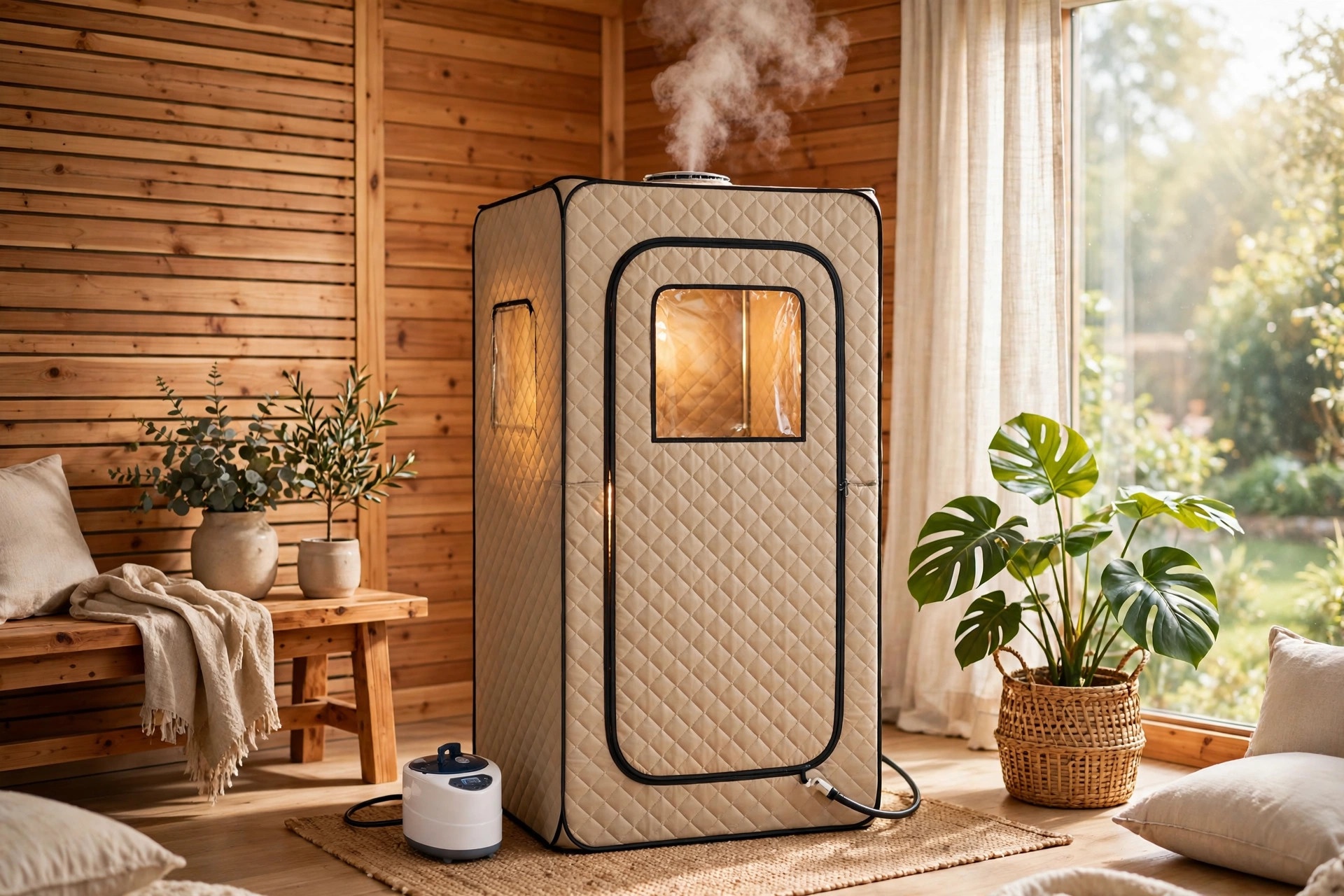
A portable steam sauna is the simplest sauna design ever sold: a fabric tent, a folding chair, and a separate steamer pot that boils water and pipes the steam inside through a hose. That is the whole machine. For around $100 to $300 you get a warm, enveloping, very humid session in a corner of a bedroom or bathroom, in a tent that folds away afterward. This page explains how steam tents work, why their temperatures feel hotter than the numbers suggest, which model we would start with, what to check on the dozens of look-alike white-label versions, and — just as important — the drying routine that decides whether a steam tent stays pleasant or turns into the category's best-known complaint.
On this page
How a steam tent works
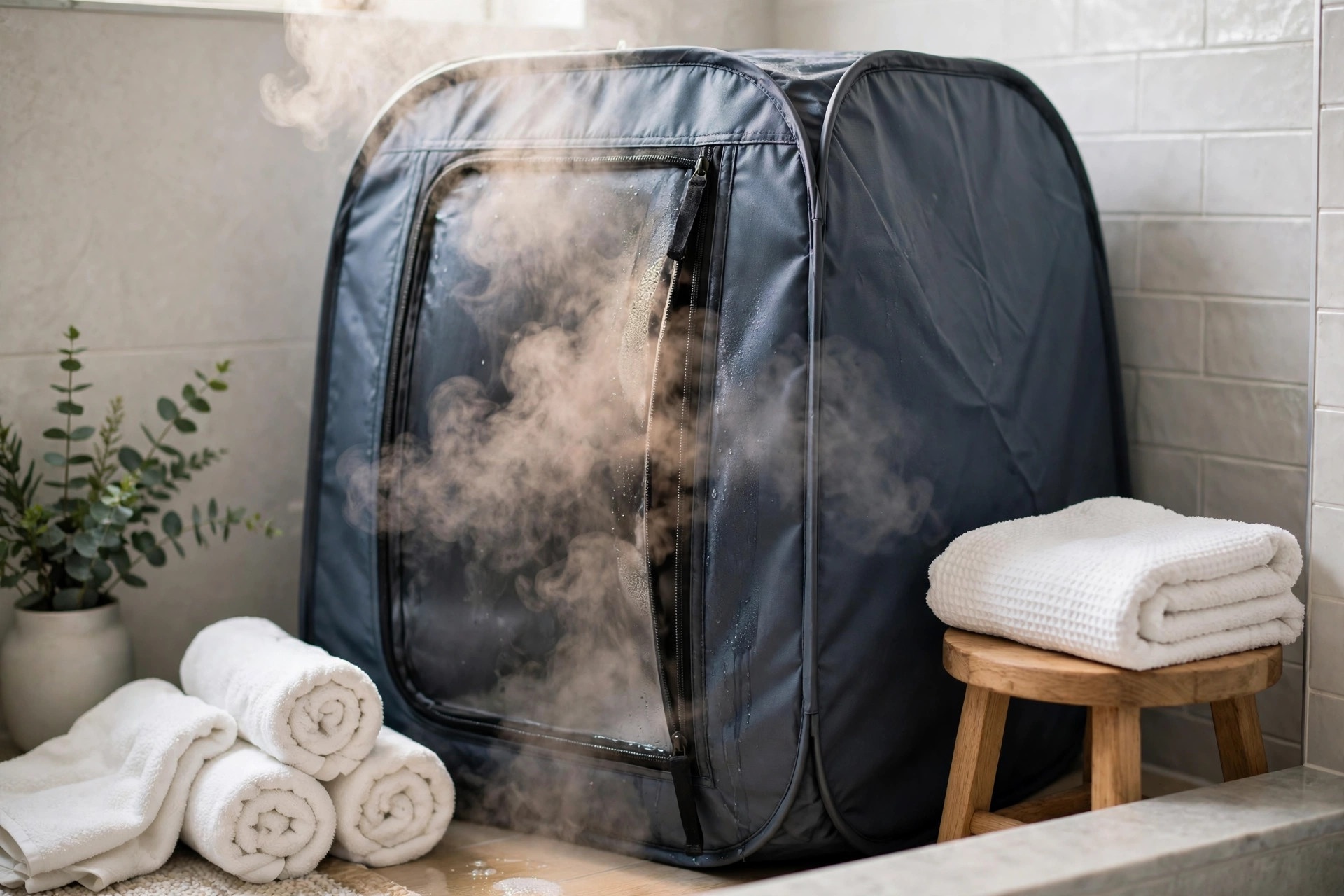
The steamer pot is the engine. You fill it with water, switch it on, and it boils — much like a large kettle. A hose carries the steam from the pot into the tent, where it spreads through the enclosed fabric space and condenses on every cooler surface: the tent walls, the chair, and you. Most tents are fully enclosing, with a zip you close behind you; some designs leave an opening at the neck, but the classic steam tent surrounds you completely. A handheld remote or a control on the pot sets the session timer and the steam level, and a floor mat catches the considerable amount of water that condenses and drips during a session.
Because the heat source is boiling water, the temperature ceiling of the format is set by physics and by how much steam a small pot can push into a leaky fabric box. In practice, portable steam tents run at roughly 110–140°F. That is the honest range for the whole category, whatever an individual listing implies. The better models hold the top of that range steadily; the cheapest ones drift lower as the pot cycles. What every steam tent delivers, regardless of price, is humidity at or near 100% — and that, as the next section explains, changes how the heat feels entirely.
Why 130°F steam feels hotter than it sounds
If you have only ever experienced dry heat, a steam tent's numbers look mild. They are not mild in practice, and the reason is straightforward physiology, stated without any medical promises: your body cools itself by sweating, and sweat only cools you when it evaporates. Inside a steam tent the air is already saturated — at 100% humidity, sweat cannot evaporate into it. So the cooling system you rely on everywhere else largely stops working, the heat you produce stays with you, and 130–140°F in saturated air feels dramatically hotter than the same number in dry air. Owners consistently describe steam tent sessions as intense, and short sessions are the sensible way to start.
Steam truth The real temperatures, plainly
Portable steam tents run at about 110–140°F at near 100% humidity. That is genuinely hot to sit in, because the humidity blocks sweat evaporation — but it is not Finnish sauna heat. A traditional Finnish sauna runs far hotter, in much drier air, and no steam tent reproduces it. The only portable format that reaches true Finnish temperatures is the wood-fired tent in our Sweat Tent review (180–220°F). Any steam tent listing that blurs this distinction is marketing, not measurement.
It is also worth saying what steam is not. Steam tents are sold elsewhere with sweeping promises, and we don't repeat detox claims — the evidence doesn't support them. What a steam tent honestly offers is warmth, deep humidity, relaxation, and a ritual: fifteen or twenty quiet minutes that feel like a small, private steam room. That is a perfectly good reason to own one, and it does not need inflating.
The hero pick: SaunaBox SmartSteam Pro
SaunaBox SmartSteam Pro
The SaunaBox SmartSteam Pro is the category's best-known direct-to-consumer product, and it earns the hero spot on this page on specification rather than fame. It reaches 130–140°F — the top of the honest steam range — driven by a 3.6L steamer, which sits in the larger tank class that matters for uninterrupted sessions (see the buying guide below). Setup is around ten minutes, the kit is complete, and it carries a 1-year warranty. A version with red light is also sold at $399 against a $500 list price. SaunaBox's own site reports 1,890+ reviews at 4.9 out of 5 — that is the brand's own figure, published on its own store, and we attribute it as a brand claim rather than an independent count.
What we like
- Reaches the top of the real steam range: 130–140°F
- 3.6L steamer — the larger tank class, fewer mid-session refills
- Complete kit with ~10-minute setup and a 1-year warranty
Downsides
- Costs about three times the cheapest white-label tents
- Still a steam tent: the drying routine in the care section below applies in full
- The headline review count is the brand's own figure
Our dedicated SaunaBox SmartSteam review goes deeper — including who this tent is not for. If you are comparing formats rather than models, the best portable saunas flagship guide puts steam tents alongside infrared tents, blankets, and the wood-fired option in one table.
The white-label buying guide: what to check on everything else
Below the SaunaBox, the steam tent market is a shelf of white-label products — similar-looking tents sold under many names through Amazon, Target, and Home Depot, often built around comparable pots and frames. That does not make them bad purchases; it makes the checklist below the whole game. Prices from our November 2026 research: Costway at about $105.99, VEVOR between $189.90 and $217.51 depending on the model and store, the Warmounts 2-person tent at $184.99, and the SalusHEAT Airy at $109–$159 — the Airy showed as out of stock on the brand's site at research time, so check availability before setting your heart on it. Three things separate a good white-label buy from a disappointing one.
1. Tank size — the spec that decides your session
The steamer pot's capacity decides how long the steam lasts before a refill. Look for the 3–4L class — the SaunaBox's 3.6L tank is the reference point, and ZONEMEL's 4L tank shows the larger end of what white-label models offer. Small pots, well under that class, run dry sooner, cycle more, and make longer sessions a negotiation with the kettle. If a listing hides the tank capacity, read that as information in itself.
2. Frame sturdiness
You will assemble and fold this tent repeatedly, in a wet environment, and the frame is what you lean on getting in and out. Look for a frame that locks positively, poles that do not flex alarmingly, and a tent skin that fits the frame snugly rather than sagging onto you when wet and heavy with condensation. Owner reports on the cheapest models return again and again to wobbly frames — it is the second most common complaint pattern in the category, after the care issues below.
3. Chair: included, or not?
Some kits include a folding chair; some assume you will supply your own, and a few include a chair so small that owners replace it immediately. Check three things before buying: whether a chair is in the box at all, whether it is rated for your size, and whether the tent's interior height works with a chair you already own. Sitting on the floor of a steam tent is possible but puts you in the coolest layer of air and the wettest part of the tent.
The VEVOR range is a useful reference shelf for this tier — it spans the $189.90–$217.51 band in our research, including a two-person model — and the SalusHEAT store shows the Airy line directly from its maker. Whichever route you take, confirm the tank size, the chair situation, and the current price on the seller's page; white-label listings change specifications without changing names.
Care: the section that decides everything
Here is the category's open secret, visible across owner reports for nearly every brand on this page: steam tents fail by neglect, not by engineering. A steam tent ends every session soaked — the walls, the mat, the chair, the floor beneath it. Left zipped up and damp in a corner, that warm, wet, dark fabric is exactly where mold grows, and the seams and hose connections are where leaks start. Mold and leak complaints are the known failure pattern of this entire category, and they are largely preventable with a routine that takes a few minutes:
- Dry the tent after every session. Not most sessions — every session. This is the single habit that separates owners who love these tents from owners who warn people off them.
- Wipe down the interior — walls, mat, and chair — with a dry cloth or towel once the session ends and the steam has cleared.
- Leave the tent unzipped to air until it is fully dry before folding it away. If you can, let it stand open in a ventilated spot; never store it damp.
- Empty and dry the steamer pot and hose as well, and check the hose connections periodically — a small drip caught early is a wipe; a leak ignored is a floor problem.
None of this is difficult, but it is non-negotiable, and it belongs in your buying decision: if you know you will not dry a tent after each use, a portable infrared sauna — a dry format with no water involved — or a sauna blanket will suit your actual habits better, and an honest guide should say so.
Who steam suits — and the alternatives
A steam tent suits people who love humidity — the enveloping, steam-room feel — want the lowest-cost route into a sit-in home sauna, and will keep up the drying routine. It suits renters (no installation, ordinary outlet, folds away) and small spaces, provided there is a spot where the tent can stand open to dry. Look elsewhere if damp and upkeep put you off (choose infrared), if you want the highest portable temperatures (only the wood-fired Sweat Tent reaches 180–220°F), or if storage is so tight that even a folding tent is too much (a blanket packs smallest). For how all four formats compare on heat and running costs, see how portable saunas work.
Practical safety notes, briefly: start with short sessions and build up, drink water before and after, and step out if you feel dizzy or unwell — saturated air makes modest temperatures feel intense. If you are pregnant, have a condition, or take medication, ask a doctor before using any sauna. Nothing on this page is medical advice. On the money side, prices here are November 2026 research figures and they change — the seller's page wins. Some buyers ask about HSA/FSA: a sauna may be eligible under some plans, so check your plan rather than assuming.
Questions
How hot does a portable steam sauna actually get?
About 110–140°F in practice, at near 100% humidity. The better models — the SaunaBox SmartSteam Pro among them — hold 130–140°F. Because the humidity blocks sweat evaporation, that feels far hotter than the same number in dry air, but it is not Finnish sauna heat, and this page will not pretend otherwise.
Is a cheap white-label steam tent worth it?
It can be, if you check the three things that matter: a tank in the 3–4L class, a sturdy frame, and a chair that is actually included and rated for you. The price shelf runs from about $105.99 (Costway) through $184.99 (Warmounts 2-person) and $189.90–$217.51 (VEVOR) — and every model at every price needs the same drying routine.
How do I stop a steam tent going moldy?
Dry it after every session: wipe down the interior, leave it unzipped to air until fully dry, and empty and dry the pot and hose. Mold complaints are the category's known failure pattern, and they track almost exactly with tents stored damp. The full routine is in the care section above.
Steam tent or infrared tent — which should I choose?
Choose steam for the humid, enveloping steam-room feel at a lower entry price, and infrared for a dry format with no water, no drying routine, and your head out in room air. Our portable infrared sauna guide covers the other side of that comparison in the same detail.